What is Gap Up and Gap Down in Stock Market Trading?
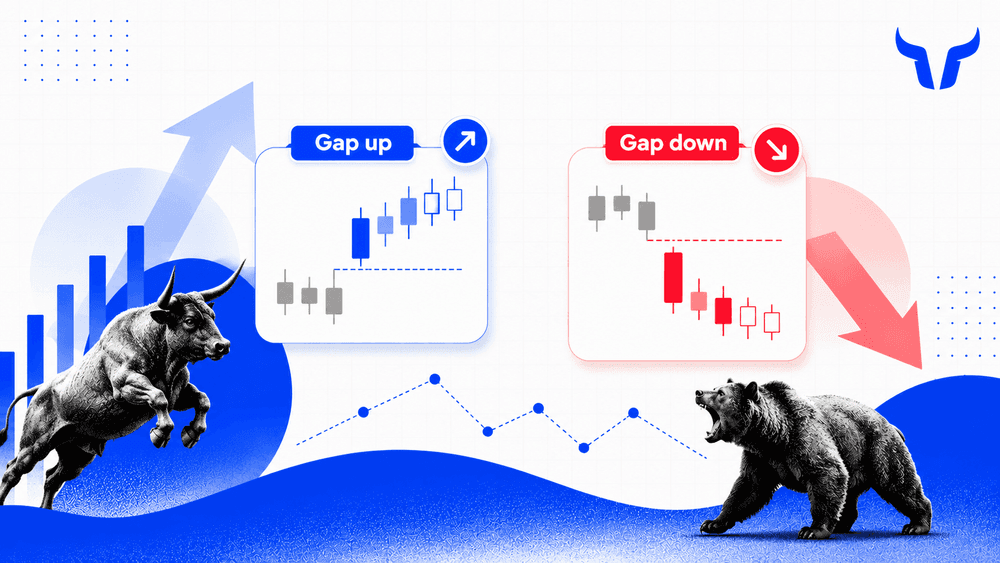
You open your trading app at 9:15 AM and a stock you have been watching has suddenly jumped by Rs 30. The market was closed all night. Nobody was trading. So how did the price move?
This is what traders call a gap, and it happens every single day in the Indian share market. Understanding what causes a gap up and gap down, how to read it, and how to act on it is one of the most practical skills you can build as a trader or investor.
Quick summary
- A gap up is when a stock opens higher than it closed the previous day. A gap down is when it opens lower.
- Gaps are caused by news that breaks after market hours: earnings results, regulatory penalties, global events.
- There are four types of gaps: common, breakaway, continuation, and exhaustion. Volume tells you which one you are looking at.
- Traders use three main approaches: ride the momentum (gap-and-go), trade against it (fade), or wait for the price to return to its old level (gap fill).
- Since SEBI increased F&O contract sizes and STT rates as per Union Budget 2025-26, cash market gap trading has become significantly more cost-effective than derivatives.
What is a gap up and gap down?
Think of your local market. A vegetable vendor closes shop on Monday evening. Overnight, a news report says onion supply has been disrupted across the state. When the vendor opens on Tuesday morning, the price of onions is already higher before a single customer has walked in. That overnight news repriced everything before trading even began.
The share market works exactly the same way. When a significant event happens after 3:30 PM, the market cannot react until the next morning. All that overnight buying and selling pressure builds up and releases the moment trading opens at 9:15 AM. The result is a gap, a visible jump or drop on the price chart where no trading happened.
A gap up occurs when a stock's opening price is noticeably higher than its previous closing price. This usually means good news arrived overnight: a strong earnings report, a business deal, a sector tailwind from global markets.
A gap down occurs when the opening price is lower than the previous close. This typically follows bad news: a regulatory penalty, a weak quarterly result, or a negative global development that spooked investors overnight.
For example: Stock of company X closes at ₹3,520 on a Thursday. After market hours, it reports Q3 results with 18% profit growth, beating analyst estimates. On Friday morning, the pre-open session discovers strong buying pressure and X opens at ₹3,695. That is a gap up of ₹175, or roughly 5%. Anyone holding X from Thursday evening woke up to an overnight gain before a single intraday trade happened.
How the gap actually forms: the pre-open session
Between 9:00 AM and 9:15 AM, the stock exchange runs a pre-open session. During this window, you can see the market but not trade in the regular sense. Traders submit their buy and sell orders based on overnight news, and exchange algorithms collect all of them. At 9:15 AM, a call auction process matches these orders to discover an equilibrium opening price that balances the overnight supply and demand. That discovered price is where the stock opens, often far from where it closed the evening before.
Watching the pre-open session gives you advance notice of how large a gap is forming and in which direction before the real trading begins.
Do not rush to buy the moment a gap up appears. The first 15 minutes after 9:15 AM are the most volatile and emotionally driven part of the trading day. Price discovery is still incomplete and retail traders are most likely to make impulsive decisions during this window. Waiting it out is often the smarter move.
What causes a gap up or gap down?
The trigger is always news that arrives after market hours. The three most common causes are:
Earnings announcements. When a company releases its quarterly results after 3:30 PM, investors immediately place pre-market orders to respond. A strong beat gaps the stock up. A miss gaps it down.
Corporate developments. A sudden leadership change, a major acquisition, an unexpected legal penalty, or a rating upgrade from an analyst can force an instant repricing of a stock overnight.
Global and macroeconomic events. Indian markets are connected to global ones. A sharp move in US futures, a change in oil prices, or a policy decision by the US Federal Reserve overnight will show up in the gap at 9:15 AM the next morning.
Earnings season is the most unpredictable time for overnight gaps. If you hold a stock in a company about to report results, expect a potentially large move at the open and have a plan for either direction before the announcement.
The 4 types of gaps and how to tell them apart
Not all gaps mean the same thing. Seeing a gap on your chart is just the start. The real skill is identifying what type of gap it is, because that tells you what the market is actually saying.
Common gap. These happen frequently, often when trading volume is low and there is no major news. They do not signal a change in the stock's direction. Most common gaps fill within a few trading sessions, meaning the price drifts back to where it was before the gap. If you see a small gap with no real news behind it and volume is flat, this is almost certainly a common gap.
Breakaway gap. A breakaway gap signals that a stock is breaking out of a long period of sideways movement into a fresh trend. These gaps come with a surge in trading volume that is noticeably above average. Because the momentum is strong, breakaway gaps rarely fill quickly. They often mark the beginning of a sustained move in one direction.
Continuation gap (also called a runaway gap). This type appears in the middle of a trend that is already well underway. If a stock has been climbing steadily for weeks and then gaps up again, it is a continuation gap. It signals that buyers who were waiting on the sidelines have finally jumped in, accelerating the existing trend.
Exhaustion gap. An exhaustion gap appears near the end of a long trend. It looks similar to a continuation gap but happens when the trend is nearly spent. Buyers make one final push, often on declining volume, before the trend reverses. Catching this type correctly and trading against it is one of the most profitable moves in gap trading, and also one of the hardest to time.
The simplest way to tell these apart: check the volume. A breakaway gap explodes with high volume. An exhaustion gap often fades with lower volume than the moves that preceded it. When in doubt, volume is the deciding signal.
Volume is your best tool for identifying which type of gap you are looking at. High volume confirms a breakaway or continuation. Low volume raises the suspicion of a common or exhaustion gap.
How to trade a gap up or gap down: three strategies
Understanding gap up and gap down is only half the picture. The other half is knowing what to do when you see one. Traders rely on three main approaches depending on what type of gap they are dealing with and how the broader market is behaving.
Gap-and-go: ride the momentum
This strategy works best with breakaway and continuation gaps. The idea is straightforward. When a stock gaps up on high volume and the news behind it is genuinely significant, the momentum often continues for at least the first hour of trading.
Imagine Rohit, a trader in Pune, sees a stock gap up 4% at 9:15 AM after the company reported quarterly profits that beat estimates by a wide margin. Volume in the pre-open session is three times the daily average. Rohit waits for the first 5 minutes to pass and confirms the stock is holding above the gap level. He enters, sets a stop-loss just below the open price, and rides the momentum for the first hour.
The same logic works in reverse for a gap down. If a stock gaps down sharply on bad news with heavy volume, a trader can take a short position expecting the selling to continue.
Fade the gap: trade against the move
Fading means you go against the gap, betting that the market has overreacted and the price will return to its previous level. This approach works best with common and exhaustion gaps.
If a stock gaps up 6% on news that seems relatively minor, or gaps up near the end of a very long rally, a fade trader takes the opposite side. They expect the initial excitement to wear off and the price to come back down. Fading requires discipline and a tight stop-loss because if you are wrong and the momentum continues, losses can build quickly.
Wait for the gap to fill
This is the most conservative approach and suits investors more than traders. Instead of acting at 9:15 AM, you wait. You watch the stock to see if it starts drifting back toward the level it was at before the gap. If it does, that old level often acts as support, and buying there gives you a cleaner entry with less noise around it.
Many common gaps fill within 3 to 5 trading sessions. Waiting for the fill and buying at support removes most of the early morning volatility from your trade.
| Strategy | Best gap type | Volume signal | Risk level | Suitable for |
|---|---|---|---|---|
| Gap-and-go | Breakaway, continuation | High | Medium-High | Active traders |
| Fade the gap | Common, exhaustion | Low or declining | High | Experienced traders |
| Wait for gap fill | Common | Low | Low | Beginners, investors |
Managing your risk across all three strategies
Whichever approach you use, a stop-loss is always recommended. Gap up and gap down trading is high volatility by definition. The first 15 minutes after 9:15 AM can move a stock 2% in either direction in seconds. Decide your maximum loss before you enter, set the stop-loss order before you buy, and do not move it further out because the trade is going against you.
Gap down strategies mirror gap up strategies in reverse. A gap down on high volume with strong negative news can be faded upward if it looks like an exhaustion move, or traded with the momentum if it is a breakaway breakdown. The type of gap and volume tell you which direction to lean.
How SEBI's 2026 rules changed gap trading in India
If you plan to trade overnight gaps, understanding India's latest regulatory environment matters. SEBI introduced significant changes between 2024 and 2026 that directly affect how cost-effective gap trading is.
The F&O cost increase. Many traders historically used Futures and Options to trade gaps because derivatives offer leverage. You could control a large position with a smaller upfront amount. As per the Union Budget 2025-26, the Securities Transaction Tax (STT) on derivatives was sharply increased. The STT on selling equity futures rose to 0.05%. The STT on selling options rose to 0.15%. Additionally, SEBI raised the minimum contract size for index derivatives to the Rs 15 to Rs 20 lakh range. Together, these changes mean you need significantly more capital and pay more in tax on every derivative trade.
Where the opportunity shifted. The government deliberately kept STT unchanged for standard equity delivery and intraday trades in the cash market. This makes cash market gap trading far more cost-effective than derivatives today. You buy actual shares, keep your position sizes manageable, and avoid the heavier tax drag on every trade.
Coupled with India's T+0 settlement cycle for the top 500 stocks, this makes cash market gap trading genuinely practical. If you buy into a morning gap at 9:15 AM and sell by 1:00 PM, your funds can be credited to your bank account the same afternoon under T+0 settlement.
With derivative costs rising and cash market charges staying flat, gap trading in actual shares is now more accessible and less expensive than F&O gap trading for most retail investors.
What gap trading actually costs you
The profit you see on screen is not the profit you take home. Before entering any gap trade, calculate your break-even point.
Brokerage. Most discount brokers charge a flat fee of around Rs 20 per trade. Some charge nothing on delivery trades.
Securities Transaction Tax (STT). Applied automatically on every trade. Non-negotiable.
DP charges. Every time you sell delivery shares from your Demat account, a flat Depository Participant charge applies, usually Rs 13 to Rs 20 plus GST per stock per day of selling. If you sell five different stocks to lock in gap-up profits on the same day, you pay five separate DP charges.
Capital gains tax. If you buy a stock and sell it within 12 months, your profit is a Short-Term Capital Gain (STCG) taxed at 20%. Take Priya, a trader from Surat who makes Rs 10,000 profit closing a gap trade. She pays Rs 2,000 in STCG tax, leaving her with Rs 8,000 before brokerage and DP charges. Her actual target profit needs to account for all three costs before she enters the trade.
| Cost | Rate | Who it applies to |
|---|---|---|
| Brokerage | ~Rs 20 flat or zero | Everyone |
| STT (cash market) | 0.1% on sell side | Everyone |
| DP charges | Rs 13-20 + GST per stock sold | Delivery trades only |
| STCG tax | 20% on profit | Held under 12 months |
Before entering any gap trade, calculate how much the stock needs to move just for you to break even after brokerage, STT, DP charges, and the 20% tax. A gap that looks large on the chart can disappear entirely once costs are accounted for on a small position.
Frequently asked questions
What is a gap up and gap down in the stock market?
A gap up is when a stock's opening price is noticeably higher than its previous closing price. A gap down is when it opens lower. Both happen because significant news arrives after market hours, when normal trading is closed, and the price adjusts the next morning when the market reopens at 9:15 AM.
What causes a stock to gap up or gap down?
The most common causes are earnings announcements released after 3:30 PM, major corporate news such as leadership changes or acquisitions, and global events that shift investor sentiment overnight. The gap size reflects how large the overnight order imbalance is relative to normal trading.
Do gaps always get filled?
No. Common gaps, which occur without major news or volume, often fill within 3 to 5 trading sessions as prices drift back to pre-gap levels. Breakaway gaps, which signal the start of a strong new trend, can go unfilled for months or never fill at all. Volume is the key indicator: high volume suggests the gap will hold, low volume suggests it may fill.
What are the 4 types of gaps?
Common gaps occur on low volume with no major news and fill quickly. Breakaway gaps occur on high volume and signal a new trend beginning. Continuation gaps appear mid-trend on high volume and confirm the trend is accelerating. Exhaustion gaps appear near the end of a trend on declining volume and signal a likely reversal.
What is the best gap trading strategy for beginners?
Waiting for the gap to fill is the safest approach for beginners. Rather than entering at 9:15 AM during peak volatility, you watch the stock and wait for the price to drift back toward its pre-gap level. That level often acts as support, giving you a cleaner and calmer entry point.
How does T+0 settlement help gap traders?
Under India's T+0 settlement cycle, available for the top 500 stocks, funds from shares sold before 1:30 PM are credited to your bank account the same day. This means a gap trader who buys at 9:15 AM and sells by midday gets their cash back the same afternoon rather than waiting until the next business day.
How are profits from gap trading taxed?
If you buy and sell shares within 12 months, the profit is a Short-Term Capital Gain (STCG) taxed at a flat 20%. There is no Rs 1.25 lakh exemption for STCG. That exemption applies only to Long-Term Capital Gains held over 12 months. Always account for this 20% tax when calculating whether a gap trade is worth entering.
Why did SEBI's new rules make F&O gap trading more expensive?
As per the Union Budget 2025-26, the STT on selling equity futures rose to 0.05% and on selling options to 0.15%. SEBI also raised index derivative minimum contract sizes to Rs 15-20 lakh. This significantly increased the cost and capital requirement of using derivatives to trade gaps, making cash market gap trading a more practical choice for most retail traders.
Disclaimer: This article is for educational purposes only and does not constitute financial or investment advice. Tax rates and SEBI regulations are based on Union Budget 2025-26 rules and may change. Please consult a SEBI-registered financial advisor or Research Analyst before making trading decisions.
