What is Non-Tax Revenue and Why It Matters for Your Investments
You just filed your income tax return. You paid what you owed. And somewhere in the back of your mind, you have wondered: where exactly does all this money go, and is there any other way the government funds itself beyond taking it from people like you?
There is. And understanding it changes how you think about your investments.
Quick summary
- Non-tax revenue is money the government earns from its own investments, services, and assets. Not from taxing you.
- For 2026-27, the government expects Rs 6.66 lakh crore from non-tax sources. Over half of it comes from RBI and public sector company dividends alone.
- When non-tax revenue is strong, the government borrows less. When it borrows less, interest rates stay stable. Stable interest rates are good for equity markets.
- Infrastructure spending funded by non-tax revenue directly lifts the earnings of construction, railway, and defence companies.
- Strong non-tax collections mean the government is less likely to raise your taxes to balance the budget.
What is non-tax revenue?
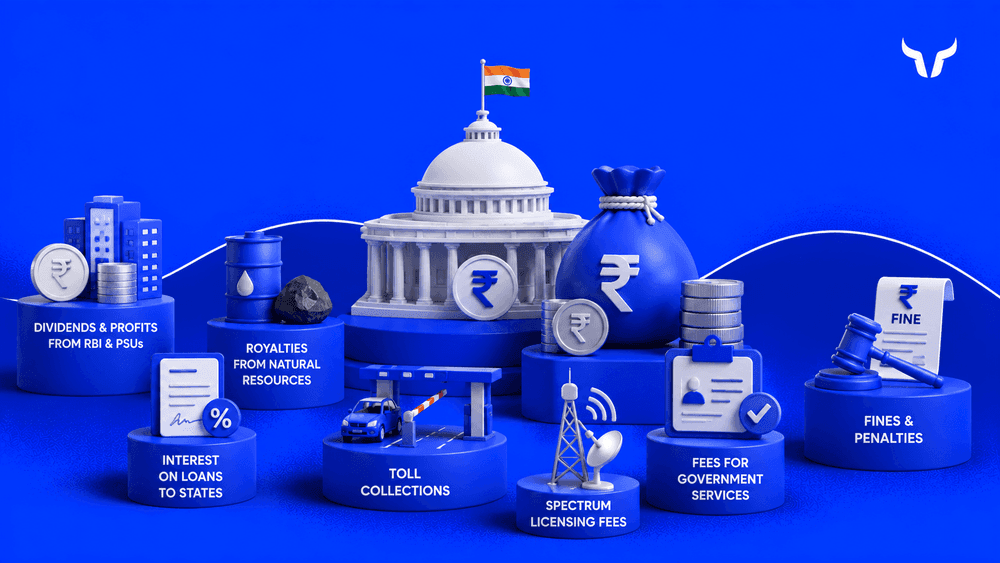
Non-tax revenue is the income the government earns from sources other than taxes. It includes dividends from companies it owns, fees for services it provides, interest on loans it gives to states, and payments for using government-owned resources like highways and telecom.
When a telecom operator pays for spectrum, when ONGC pays a dividend, when you pay a passport fee, that money reaches the government without a single new tax being levied. Tax is compulsory. Non-tax revenue is earned.
Where does this money actually come from?
For 2026-27, the government has projected Rs 6.66 lakh crore in non-tax revenue. It was Rs 5.45 lakh crore in 2024-25 and Rs 5.83 lakh crore in 2025-26. The trend is upward, driven largely by stronger RBI and PSU dividends. Here is where it comes from.
Dividends and profits from the RBI and public sector companies
The RBI and government-owned companies like ONGC and NTPC send their profits to the government each year. This single source accounts for 59% of all non-tax revenue, roughly Rs 3.93 lakh crore, per PRS India's analysis of the Union Budget 2026-27.
Royalties from natural resources
When private companies extract oil, gas, coal, or minerals from government-owned land, they pay a royalty to the government. ONGC, Vedanta, and Coal India are among the companies from which such royalties flow
Interest on loans to states
The central government lends money to state governments at negotiated rates. The interest collected on these loans is a steady, predictable source of non-tax income.
Toll collections
Every time a truck drives down a national highway or a car passes through a toll booth, a small amount flows into the national treasury.
Spectrum licensing fees
Telecom companies pay the government for the right to use radio frequency spectrum, the invisible infrastructure that powers your mobile network. These are large, periodic payments that show up in non-tax revenue when spectrum auctions happen.
Fees for government services
Every time someone applies for a passport, renews a driving licence, registers a property, pays an exam fee for UPSC or SSC, or gets a PAN card processed, the government collects a fee. These are small individually but add up significantly at scale.
Fines and penalties
When someone pays a traffic challan, a late GST filing penalty, or a court-imposed fine, that money flows into the government's non-tax revenue. This source is less predictable than dividends or fees, but it is real and growing as digital enforcement improves.
What is the difference between tax and non-tax revenue?
The clearest way to understand the difference is through the question of compulsion.
When you earn a salary above a certain threshold, you pay income tax. You do not get to choose. When a company sells goods, it charges GST. That is compulsory. Tax revenue flows to the government regardless of what the government does or does not do for you specifically.
Non-tax revenue is different. You only pay a highway toll if you drive on that highway. A telecom company only pays for spectrum if it wants to operate a mobile network. The government only receives RBI dividends if the RBI has been profitable. There is a direct link between an activity, an asset, or a service and the income generated.
| Tax Revenue | Non-Tax Revenue | |
|---|---|---|
| Nature | Compulsory | From assets, usage-based services, or government investments |
| Primary sources | Income Tax, GST, customs | RBI dividends, PSU profits, tolls, spectrum fees, royalties, service fees, fines |
| Your direct link | You pay regardless of specific service received | You only contribute if you use the service or benefit from the asset |
One confusion worth clearing up: disinvestment is not non-tax revenue
When NTPC pays the government a dividend from its profits, that is non-tax revenue. Recurring income the government earns as a shareholder.
When the government sells part of its stake in NTPC, that is disinvestment. A one-time capital receipt, not a return on ownership.
The difference matters for investors. Strong non-tax revenue means the government is earning well from assets it still owns. Heavy disinvestment often means other revenue sources are falling short. A government meeting its fiscal targets primarily through asset sales has a weaker underlying revenue position than the headline numbers suggest.
How does non-tax revenue affect your investments?
The government funds its spending through revenue (tax plus non-tax) and borrowing. When non-tax revenue is strong, the gap between spending and income narrows. The government borrows less, which means less competition for money in the financial system. Interest rates stay stable, and stable interest rates support equity markets.
Strong non-tax collections also mean more money available for capital expenditure: roads, railways, ports, defence procurement. Companies that win those contracts see their order books fill up, their revenues grow, and their share prices eventually reflect that.
Meet Ananya, a 32-year-old teacher from Bhopal who invests Rs 3,000 every month in a Nifty 50 index fund through DreamStreet. She does not watch government budgets closely. But when non-tax revenue comes in strong, the government borrows less, rates stay stable, and infrastructure spending rises. All three work in favour of her index fund. This is how an RBI dividend transfer in May ends up affecting her returns by October.
During Budget season, watch the government's non-tax revenue projections alongside the capital expenditure numbers. Strong non-tax revenue projections usually mean higher infrastructure spending is coming, which historically benefits companies in the construction, railway, and defence sectors. On DreamStreet, you can filter stocks by sector to see which infrastructure companies are in your watchlist or portfolio.
Why this matters even if you never pay a toll or use spectrum
Every rupee the government collects from non-tax sources is one rupee it does not need to borrow from the market or one rupee it does not need to raise from higher taxes. The less the government borrows, the more credit is available for private businesses and individuals. The more efficient the government's revenue mix, the less pressure there is to increase direct or indirect taxes on you.
Strong non-tax revenue is essentially a signal that the government's balance sheet is healthy. And a government with a healthy balance sheet is one that invests in growth, keeps borrowing costs low, and is less likely to reach into your pocket.
FAQs
What is non-tax revenue?
Income the government earns from sources other than taxes: RBI dividends, PSU profits, highway tolls, spectrum fees, and interest on loans to states. For 2026-27, the projected total is Rs 6.66 lakh crore.
Why does the RBI transfer money to the government?
The RBI earns profits from managing India's foreign exchange reserves and holding government securities. After setting aside money for its own reserves, it transfers the remaining surplus to the government. This is one of the largest single items in non-tax revenue.
How does non-tax revenue affect the stock market?
When non-tax revenue is strong, the government borrows less. Less borrowing keeps interest rates stable, which supports equity markets. The surplus also funds infrastructure spending, which boosts earnings for companies in construction, railways, and defence.
How does non-tax revenue impact retail investors directly?
Two ways. Stable interest rates make equities more attractive. And a government earning well from non-tax sources is under less pressure to raise income tax or capital gains tax rates in the next budget.
Disclaimer: This article is for educational purposes only and does not constitute financial or investment advice. Budget figures referenced are based on the Union Budget 2026-27. Please consult a SEBI-registered financial advisor before making investment decisions.
