Balanced Fund vs Balanced Advantage Fund: Which is Better for SIPs and One-time?
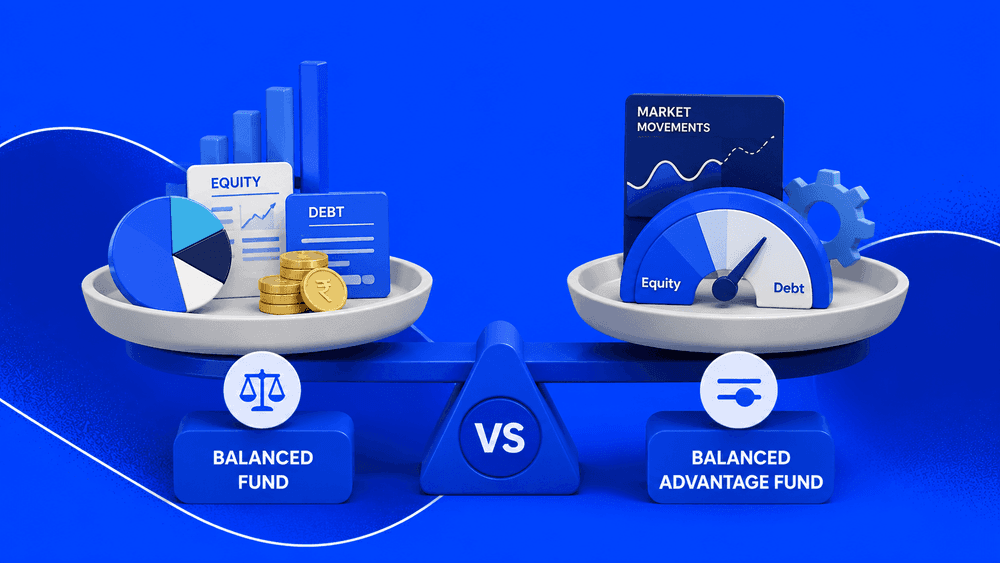
You have found a mutual fund you like. It invests in both shares and bonds. It looks stable. And then you notice there are two versions of it: one called a Balanced Fund and one called a Balanced Advantage Fund. They sound nearly identical. The returns look similar. The risk labels are close.
So which one do you actually pick?
This is one of the most common confusions in Indian mutual fund investing right now. The balanced fund vs balanced advantage fund decision is not just a technical distinction. It changes how your money behaves in a market crash, how much protection you get on a one-time investment, and how well your SIP actually works.
This guide explains both in plain language so you can make the right call.
Quick Summary
- A Balanced Fund (officially an Aggressive Hybrid Fund as per SEBI's mutual fund categorisation) always keeps 65% to 80% of your money in shares, no matter what the market does. Best for monthly SIPs.
- A Balanced Advantage Fund (BAF), officially called a Dynamic Asset Allocation Fund, shifts freely between shares and bonds based on how expensive the market is. Best for one-time investments.
- Both funds are taxed like equity mutual funds. Short-term gains (under 12 months) are taxed at 20%. Long-term gains (over 12 months) are taxed at 12.5%, and your first ₹1.25 lakh of long-term profit every year is tax-free.
- Even if your salary is below the tax-free limit, you still pay capital gains tax on your fund profits. The two are calculated separately.
- SOA mode (holding directly through a fund house or app) has no annual fees. Demat mode comes with annual maintenance charges.
What is a Balanced Fund?
A Balanced Fund, now officially classified as an Aggressive Hybrid Fund by SEBI, works with a strict, fixed rule. It must keep between 65% and 80% of your money in equity (shares) at all times. The remaining 20% to 35% goes into debt (bonds). The fund manager has no power to change this, no matter what the market does.
Think of it as a car on cruise control. The fund manager sets the speed and stays in their lane. Even if the road ahead looks rough and share prices are falling sharply, they cannot hit the brakes and move your money to safety. The 65% floor is a regulatory requirement. They have to stay above it.
This sounds like a limitation, and in some ways it is. But it is also exactly what makes this fund predictable. You always know roughly how your money is allocated. There are no surprises about what the fund manager did last month.
Meet Rohit, a government employee in Nagpur who invests ₹5,000 every month. He does not want to think too much about his investments. He just wants something steady that grows over the years. Rohit does not need a fund manager who second-guesses the market every week. He needs one who stays the course. A Balanced Fund is built for him.
The trade-off is that when the market drops hard, this fund drops with it. Because equity is always high, there is no automatic move to safety. You are taking on moderately high risk in exchange for capturing the full benefit of market rallies over time.
Why a Balanced Fund Works Well for SIPs
Here is something most investors do not think about: the fixed high equity allocation of a Balanced Fund is actually an advantage when you invest monthly through a SIP.
When the market falls and share prices drop, your monthly SIP buys more units at lower prices. Over time, this brings your average cost down. It is called rupee cost averaging, and it is one of the most reliable wealth-building tools available to a regular investor. A Balanced Fund's rigid equity allocation keeps this mechanism working at full strength every single month.
A Balanced Advantage Fund, as you will see next, actually reduces equity during market dips. That sounds protective, but it also means your SIP buys fewer shares when prices are low, which is the opposite of what you want.
Smart Investor Tip: Balanced Funds are well-suited for SIPs precisely because of their fixed equity allocation. Every market dip is an opportunity to buy more units at lower prices. A fund that reduces equity during dips takes that opportunity away from you.
What is a Balanced Advantage Fund (BAF)?
A Balanced Advantage Fund, officially called a Dynamic Asset Allocation Fund, has no fixed rules about how much to keep in shares or bonds. The fund manager can put 0% in equity and 100% in debt, or the other way around, depending entirely on what the market looks like right now. This is complete freedom to manage risk in real time.
If a Balanced Fund is a car on cruise control, a BAF is a skilled driver navigating a busy city road. When the road ahead is clear and share prices are reasonably valued, the driver accelerates. When the road is congested and the market looks overpriced and risky, the driver eases off and moves your money into the safety of bonds.
The manager does not do this on instinct or gut feel. BAF managers use financial valuation models to make this call objectively. The two most commonly used measures are the Price-to-Earnings (PE) ratio and the Price-to-Book (PB) ratio of the broader market. When PE and PB ratios climb high, shares are expensive, and the fund reduces equity exposure. When they fall, shares are cheap again, and the fund increases equity to prepare for the rebound.
Meet Priya, a software developer in Hyderabad who just received a ₹3 lakh annual bonus. She has been wanting to invest for a while, but she is nervous. What if she puts in all this money just before a market crash? She would be buying at the peak, and every newspaper headline would make her feel sick. A BAF is the right choice for Priya. The fund manager watches the valuation signals and reduces risk automatically if the market is stretched. Priya does not need to time anything herself.
Why a BAF Works Well for One-time Investments
When you invest a large amount all at once, your returns depend heavily on what the market does immediately after you invest. Buy at the top and a 20% correction wipes out years of growth. A BAF removes most of that timing pressure. If the market is overvalued when you invest, the fund moves to bonds and waits. When the market corrects and shares become attractive again, the fund shifts back to equity to capture the recovery.
The most common mistake first-gen investors make with these two funds is using them the wrong way around: a Balanced Fund for a one-time investment, and a BAF for a SIP. That is exactly the reverse of what works. A Balanced Fund's fixed equity maximises your SIP's rupee cost averaging. A BAF's flexibility protects your one-time investment from entering at a market peak.
Balanced Fund vs Balanced Advantage Fund: Side by Side
| Feature | Balanced Fund | Balanced Advantage Fund (BAF) |
|---|---|---|
| Official SEBI name | Aggressive Hybrid Fund | Dynamic Asset Allocation Fund |
| Equity allocation | Fixed: 65% to 80% | Dynamic: 0% to 100% |
| Manager control | Low. Must stay within regulatory limits. | High. Shifts based on market valuations. |
| Risk level | Moderately high. Bigger impact during crashes. | Moderate. Better at protecting capital in downturns. |
| Best suited for | Monthly SIPs | One-time investments |
| Expense ratio | Lower, due to fixed strategy | Slightly higher, due to active rebalancing |
To put this in plain language: during a long market rally, a Balanced Fund typically generates higher returns because it is always heavily in equity. When share prices fall hard, a BAF protects more of your capital because the manager has already started moving money toward bonds. Neither is universally better. They serve different purposes, and using each one for the right situation is the whole point.
How Does a BAF Protect Your Money Without Losing Its Tax Advantage?
This is the question most investors have but rarely ask out loud.
If a BAF moves most of its money into bonds to protect you during a downturn, does it lose the equity tax treatment that makes it attractive in the first place? Equity funds get taxed at 12.5% on long-term gains. Debt funds get taxed at your income slab rate, which can be much higher. Losing equity tax status would be a significant problem.
The answer is no, and the reason is a strategy called equity arbitrage.
When a BAF reduces its real-world equity exposure, it simultaneously makes low-risk, offsetting trades in the same shares across different markets. These trades carry almost no actual risk, but they count as equity on paper. The result is that the fund stays technically above the 65% equity threshold required for equity tax status, even while the real portfolio risk has been significantly reduced.
Think of it like this: the fund is wearing a seatbelt while still looking like it is in the driver's seat. You get the protection without paying the higher tax price for it.
How Are Both Funds Taxed?
Both Balanced Funds and Balanced Advantage Funds qualify for equity taxation, provided they maintain at least 65% in domestic equities, including arbitrage positions for BAFs. This is the same tax treatment as a pure equity mutual fund.
| Holding Period | Gain Type | Tax Rate | Exemption |
|---|---|---|---|
| Less than 12 months | Short-Term Capital Gain (STCG) | 20% | None |
| More than 12 months | Long-Term Capital Gain (LTCG) | 12.5% | First ₹1.25 lakh per year is tax-free |
To see how this plays out, take Arjun, an accountant from Chennai who made ₹2 lakh in long-term profits from his mutual fund this year. His first ₹1.25 lakh is completely exempt. He pays 12.5% only on the remaining ₹75,000. That works out to ₹9,375 in tax on ₹2 lakh of profit, which is a significantly better outcome than short-term gains would have given him.
One thing most investors get wrong: The standard income tax rebate under Section 87A does not apply to capital gains from equity funds. Even if your total salary or other income is below the basic exemption limit, you still owe capital gains tax on your mutual fund profits. This surprises a lot of first-time investors when they file their returns. It is one of the most commonly misunderstood rules in mutual fund taxation in India.
Tax rates are based on the post-Budget 2024 regime and may change.
If you are close to the 12-month mark on a mutual fund investment, it is worth waiting a few more weeks before redeeming. Crossing that threshold shifts your gain from the 20% STCG rate to the 12.5% LTCG rate. On a ₹1 lakh gain, that difference is ₹7,500 saved in tax by simply waiting.
Practical Details Before You Start
How Much Do You Need to Begin?
Most Balanced Funds and BAFs accept a minimum SIP of ₹500 to ₹1,000 per month. For one-time investments, most fund houses require a minimum of ₹5,000. You do not need a large sum to get started in either category.
When Does Your Money Reach Your Bank After You Redeem?
Both fund categories follow a T+2 settlement cycle for redemptions. Place your redemption request before the daily cut-off time on a business day and the money reaches your bank account within two working days. If you need funds by a specific date, submit the redemption request at least three working days ahead to be safe.
Should You Hold in Demat Mode or SOA Mode?
When you invest in mutual funds, you choose how to hold your units. Demat mode keeps everything in one account alongside your shares. SOA (Statement of Account) mode means you hold directly through the fund house or a zero-commission platform.
For investors who only hold mutual funds, SOA mode is almost always the better choice. There are no annual maintenance fees, no DP charges when you redeem, and nothing quietly eating into your returns. Demat mode is worth considering only if you want a single dashboard showing both your shares and mutual fund units together.
Which Fund Should You Choose?
Choose a Balanced Fund (Aggressive Hybrid Fund) if:
- You invest a fixed amount every month through a SIP
- You want a predictable strategy that does not depend on a manager's market calls
- You are a long-term investor who can stay calm through market dips
Choose a Balanced Advantage Fund (BAF) if:
- You have a large, one-time amount to invest and want the fund to handle timing risk
- You are approaching a financial goal in the next 3 to 5 years and cannot afford a big drawdown
- You want automatic downside protection without monitoring the market yourself
The decision is not about which fund is better. It is about matching the fund to how you are investing. A Balanced Fund in the hands of a SIP investor and a BAF in the hands of a one-time investor, used correctly, are both excellent choices for building long-term wealth.
Frequently Asked Questions
What is the main difference between a Balanced Fund and a Balanced Advantage Fund?
A Balanced Fund keeps 65% to 80% in equity at all times regardless of market conditions. A BAF adjusts freely between 0% and 100% in equity based on valuations. The Balanced Fund is predictable and fixed. The BAF is flexible and actively managed.
Which is better for SIP: Balanced Fund or BAF?
A Balanced Fund is generally better for SIPs. Its fixed high equity allocation means your monthly SIP buys more units when the market falls, which is how rupee cost averaging builds wealth over time. A BAF reduces equity during market dips, which limits this averaging benefit.
Which is better for one-time investments: Balanced Fund or BAF?
A BAF is generally better for one-time investments. It automatically reduces equity exposure when markets are expensive, protecting a large one-time investment from the risk of entering at a peak. A Balanced Fund cannot do this because its equity allocation is fixed.
How are Balanced Funds and BAFs taxed?
Both typically qualify for equity taxation. Short-term capital gains on units held under 12 months are taxed at 20%. Long-term capital gains on units held over 12 months are taxed at 12.5%, with the first ₹1.25 lakh of long-term gains per financial year completely tax-free. Note that the Section 87A rebate does not apply to these capital gains.
What does T+2 settlement mean for mutual fund redemptions?
It means the money from your redemption reaches your bank account within two working days of placing the request. If you redeem on Monday before the cut-off, the funds arrive by Wednesday. Plan around this if you need the money by a specific date.
Is it better to hold mutual funds in Demat or SOA format?
For investors who only hold mutual funds, SOA mode is the better choice. No annual maintenance fees, no DP charges on redemption. Demat mode is useful only if you want a single screen for both your shares and mutual funds.
What valuation models do BAF managers use?
Most BAF managers rely on the Price-to-Earnings (PE) ratio and Price-to-Book (PB) ratio of the broader market. High PE and PB ratios signal an expensive market, prompting a shift toward bonds. Low ratios signal cheap shares, prompting a shift back toward equity.
Can I do a SIP in a BAF?
Yes, you can. But a SIP in a BAF is less effective than a SIP in a Balanced Fund. Because a BAF reduces equity during market falls, your monthly investment buys fewer units at lower prices, which works against the core benefit of SIP investing.
Disclaimer: This article is for educational purposes only and does not constitute financial or investment advice. Tax rates are based on the post-Budget 2024 regime and may change. Please consult a SEBI-registered financial advisor before making investment decisions.
